Procter and Procter
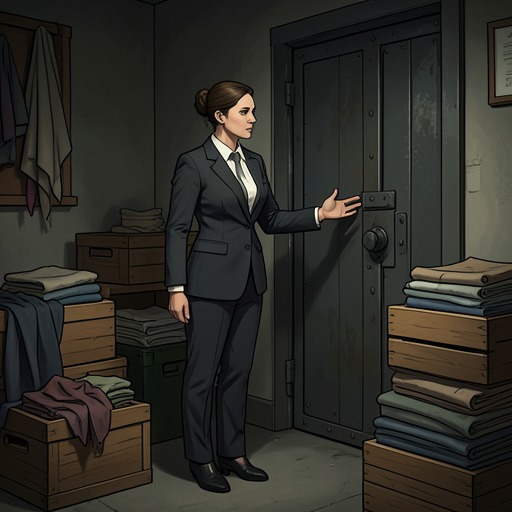
A Woman of SubstanceProcter and Procter is a wholesale cloth warehouse in Bradford that Emma Harte acquired through the Emeremm Company in 1917. Its importance grows beyond the value of its premises or trade: Emma makes it both a hidden foothold among her commercial rivals and a channel for information about Gerald Fairley. By keeping her ownership concealed and using Alan Procter as the public face of the business, she converts a troubled company into an instrument in her campaign against the Fairleys.
Business and acquisition
The warehouse offered Emma two kinds of value. It was a sound investment despite years of mismanagement, and its extensive site in central Bradford was prime land whose value she expected to rise. But the acquisition also had a personal and strategic purpose: Procter was a close associate of Gerald Fairley, whom Emma regarded as her sworn enemy. Through Procter, she could gain access to news about Gerald’s activities as well as information about other competitors in Leeds and Bradford.
Alan Procter had run the company into serious difficulty. He faced numerous creditors and personal debts, many resulting from habitual gambling, and was initially reluctant to sell. Emma’s offer was designed to overcome that resistance without appearing extravagantly generous. The purchase price was fair but not so high as to invite suspicion; in addition, Procter received a contract to remain as chairman on a salary he could not afford to refuse. The agreement required him to keep the change of ownership secret, with his employment immediately terminable if he disclosed it.
A concealed ownership structure
The secrecy suited Procter, who could continue running the warehouse, settle his personal and business debts, and preserve his standing in Bradford. He did not question why the ownership had to remain hidden. The arrangement therefore gave him the appearance of independence while placing the company under Emma’s control through Emeremm.
Emma also arranged for an Emeremm employee to work inside Procter and Procter. The newcomer was to limit the damage Procter might do to the business while winning his confidence. This was more than a change in management: Emma had designed the company as an information network. Procter’s loose talk, encouraged over leisurely business lunches with the new managing director, supplied reports about his associates and rival firms. A substantial part of the intelligence reaching Emma concerned the Fairleys.
From information to leverage
The information channel soon produced a direct commercial opportunity. Early in 1918, Emma learned through Procter that Gerald was in severe difficulty at Thompson's mill and wanted to sell it. She directed that the purchase be made for as little as possible. Emeremm used Procter and Procter as the purchaser, allowing Gerald to believe he was dealing with his old and trusted friend. In financial distress, he accepted only a quarter of the mill’s true value.
Procter and Procter also became the public route through which Gerald sought a substantial loan after losing heavily at cards. He approached Procter for £200,000, unaware that his request would be passed to the Emeremm insider and then reach Emma. She anticipated that Gerald, struggling to raise funds, would eventually accept the terms. After four days of unsuccessful efforts, he returned in panic and signed a noncontestable corporate note, attaching the deeds to the two Fairley mills as security. He still believed he was dealing with a friend who would not threaten his ownership. A week later, Emma placed the note and deeds in her safe, securing the leverage she had engineered through the company.
Exposure and significance
The concealed arrangement came into view when Gerald confronted the consequences of his dealings. He understood General Retail Trading Company as a division of Procter and Procter and believed the latter belonged to Alan Procter. Emma corrected him: Procter and Procter was a subsidiary of Emeremm, and Alan was only an employee of its parent company. She disclosed that she owned Emeremm and consequently controlled Procter and Procter and General Retail Trading Company, as well as Deerfield Estates. She then told Gerald that she owned his mills and Fairley Hall.
The revelation transformed the warehouse’s function from hidden intermediary to proof of the scale of Emma’s control. Gerald realized that the dealings he had treated as transactions with a trusted associate had helped transfer his family’s enterprises and home into Emma’s hands. Procter and Procter thus links ordinary commercial mechanisms—a fair-seeming sale, a retained chairman, a confidential employment clause, and a secured corporate note—to Emma’s larger strategy. Its role shows how business intelligence and carefully concealed ownership allowed her to turn Gerald’s financial vulnerability into lasting control of the Fairley assets.